A Tokyo Novel Without the Guidebook: Midnight Taxis, Four Chords, and the Japan You Don’t See From a Bus Window
By Akira Yano
Most books about Tokyo tell you where to go.
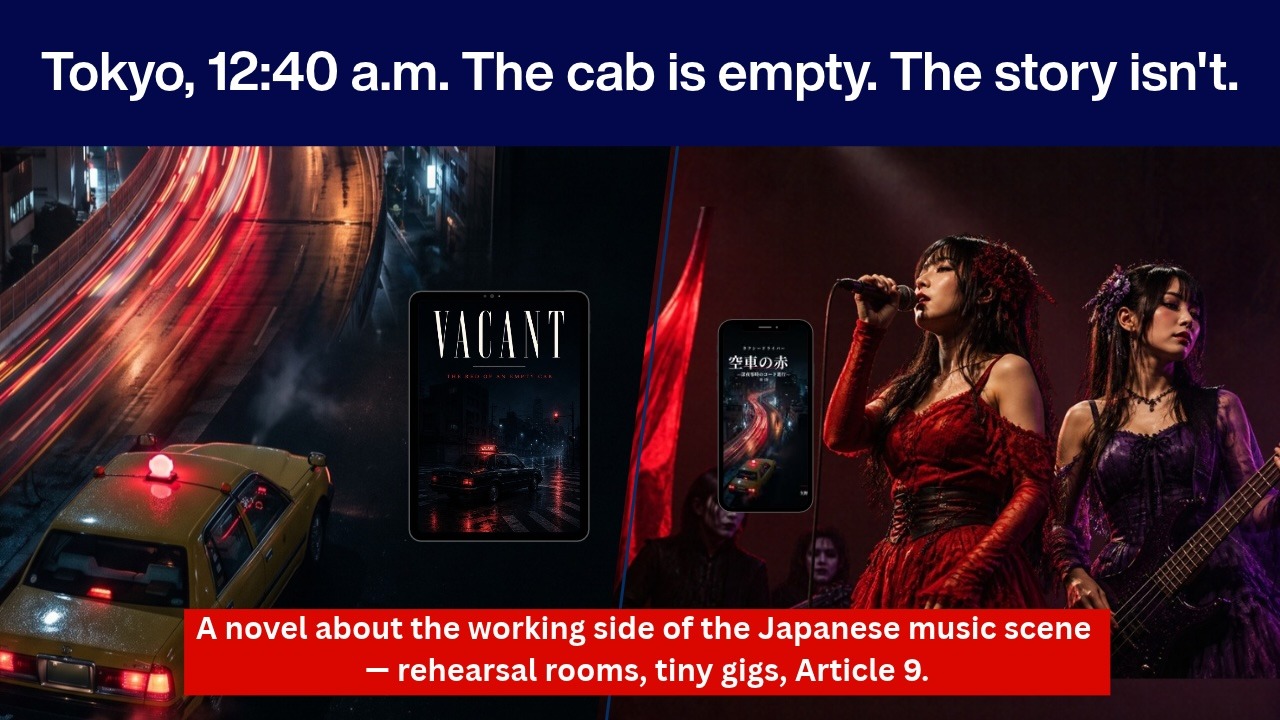
This one starts at 12:40 a.m., when the last trains have gone, the Ring Road 8 is as empty as a drained swimming pool, and a 54-year-old taxi driver is doing his best not to think about the guitar he put down thirty years ago.
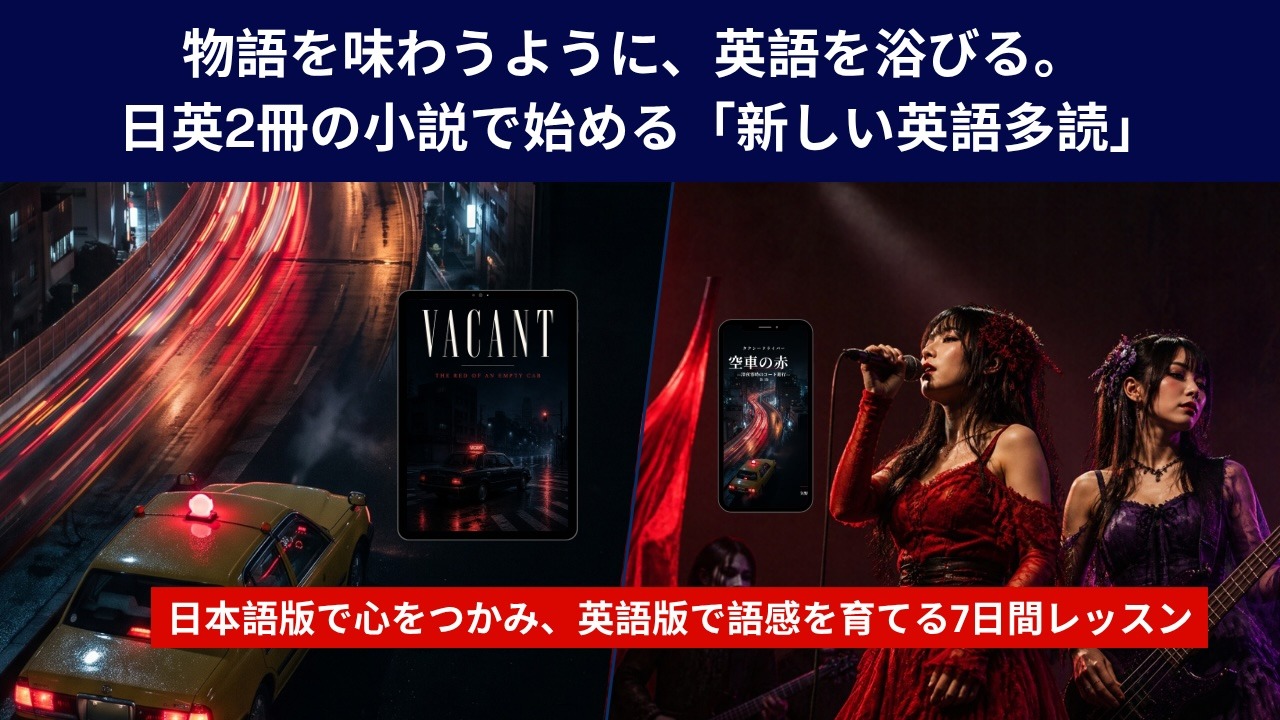
That is the opening of my novel, VACANT: The Red of an Empty Cab — The Midnight Chord Progression. It is not a travel guide. There is no neon fantasy, no samurai, no list of temples you must photograph before lunch. It is a story about ordinary people living ordinary lives in Tokyo — a driver, a young singer, three ageing bandmates, and a city that keeps moving around them whether they are ready or not.
I am Akira Yano, an English educator in Japan. This is my first novel in English, and it is now available on Amazon together with the Japanese edition. Here is what the book is about, who might enjoy it, and why it might be a better introduction to contemporary Japan than another guidebook.
1. A Tokyo Novel That Doesn’t Explain Tokyo
There are two kinds of books published for people interested in Japan: travel guides, and cultural explainers. Both look at the country from the outside. Both assume the reader is a visitor.
VACANT does the opposite. It puts you in the driver’s seat — literally. You spend the novel beside a man whose working life is spent moving through the city at night, and the city is never explained to you. Nobody pauses to tell you what a rotary is, or why a driver avoids Roppongi after eleven, or what AFN sounds like on the radio at 810 kHz. You are simply there, and you work it out the way residents do: by repetition, by habit, by overhearing.
That is the difference between reading about Japan and reading inside it. The novel’s Japan is lived in — a night shift, a familiar street, a small live house, old friends, and the difficult business of starting again.
2. The Story in Brief: A Taxi, a Girl, and Four Chords

Seiichi Murase is 54 and drives a taxi in Tokyo. He avoids Roppongi and Dogenzaka because drunk passengers are not worth the trouble. Instead he cruises Setagaya-dori at a crawl, radio on, thinking about nothing in particular. He has stopped thinking about the guitar. Or so he tells himself.
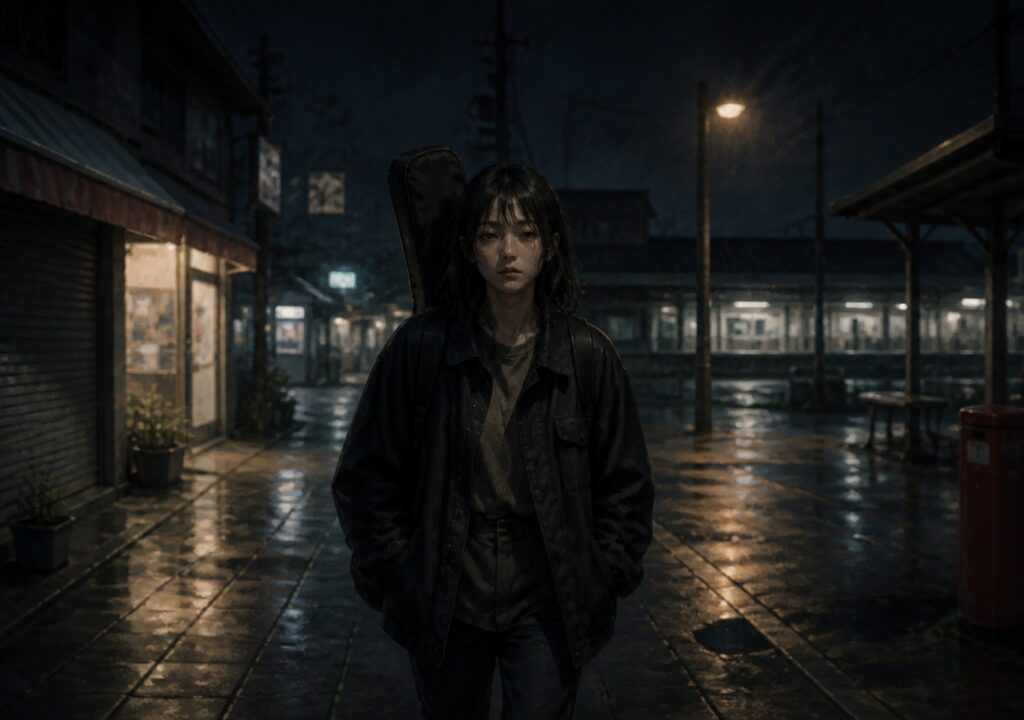
One night, at the rotary outside Soshigaya-Okura station, a 23-year-old woman gets in with a guitar on her back. Akari Mizusaki. It is a short ride and an ordinary fare. She asks him to take the long way.
Her singing has something in it she has not yet given to anyone. And for the first time in thirty years, Murase lets another person hear his own music.
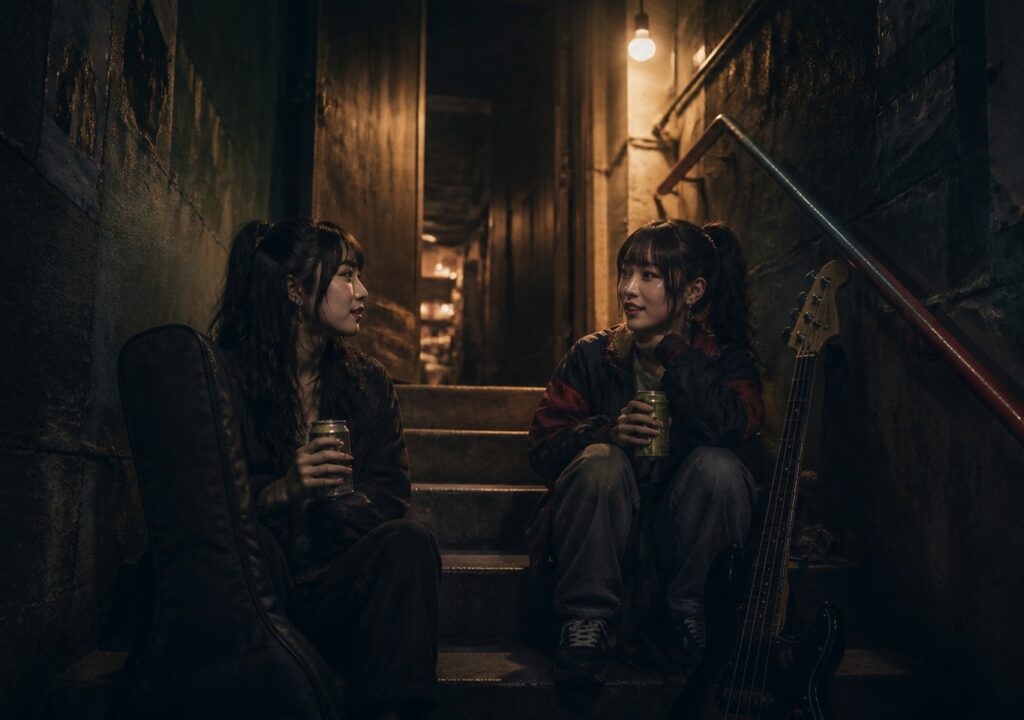
Soon he is standing in a small live house in Shimokitazawa called the Lamp Room, with the three remaining members of the band that broke up three decades earlier. The audience is three people. They play to the end anyway.
Four chords hold the whole story together: D, Bm, G, A. They repeat, shift a semitone, and never quite resolve. As the band grows — a young bassist joins, then a guitarist — so does the room. Then the machine arrives: contracts, schedules, and a clause in Article 9 about “support members.” Success changes people. A man who lost his friends once finds himself about to lose them a second time.
This is not a story about the people who won. It is a story about the people who stepped back — and about the ones who kept playing anyway.
The novel runs to three acts and fifteen chapters — Encounter and Rebirth, Formation and Collapse, and Empty Cab — and the final line returns you to the rotary in chapter one. It is Volume One of Two. The story, as the Japanese edition puts it, is still only in the middle of the night.
3. Tokyo Beyond the Postcard: The Neighborhoods in the Novel

If you know Tokyo only from photographs, this novel will re-map it for you. The places below are not sightseeing stops. They are simply where the characters work, rehearse, drink, and go home.
- Soshigaya-Okura and Setagaya-dori — the quiet western suburbs, a rotary, a slow road, the Tokyo that appears in no guidebook because there is nothing to “see” there. Which is exactly why it feels real.
- Shimokitazawa — the live-house district, small stages, second-hand clothing shops, narrow streets that smell of old wood and amplifier dust. In the novel it is where the band reassembles.
- Sangenjaya and Setagaya — residential Tokyo, the everyday city of supermarkets, laundries, and late buses.
- Shibuya and Shinjuku — the famous names, but seen from the driver’s seat: as crowds to be navigated, fares to be judged, and places to leave as quickly as politeness allows.
- Minato Mirai and Sakuragicho, Yokohama — where the story eventually travels. Waterfront light, a different pace, and the sense of a city that is not quite Tokyo at all.
Readers who have lived in Japan will recognise these details immediately. If you have never been, you will come away with something more useful than a list of attractions: a sense of how the city actually behaves at night.
4. For Fans of Japanese Pop Culture: The Working Side of the Music Scene

If you came to Japanese music through anime soundtracks, city pop playlists, or J-rock, VACANT shows you the part that usually stays off screen.
There are rehearsal studios booked by the hour. There are gigs where the audience is smaller than the band. There is the strange, awkward joy of two generations sharing one room — men who abandoned their dreams in their twenties, and a young woman still looking for her own voice. There are record-label contracts, and the quiet arithmetic of who gets credited and who gets paid.
It sits closer to the real indie scene than to idol-industry glamour. Nobody in this book is discovered on a street corner. Things move at the speed of a local train, one station at a time — which is, for anyone who has actually played in a band, the most recognisable thing about it.
5. Why This Matters If You Are Curious About Japan

You may have noticed that a lot of writing about Japan is written for consumption: the weird vending machines, the mysterious aesthetics, the “ancient and modern” contrast that gets recycled every few years. It is entertaining, and it is exhausting.
This novel offers something quieter. Its characters are middle-aged, tired, occasionally funny, and not especially exotic. They worry about money, about being too old, about whether they are the kind of person who finishes things. Their Japan is neither wacky nor mystical. It is ordinary life with music in it.
For readers of Japanese fiction in translation, the neighbours here are books like Tokyo Ueno Station — the quiet, observational strain — though VACANT is warmer, and there is a band in it.
6. A Bonus for Japanese Learners: The Art of What Isn’t Said

If you are studying Japanese, this novel has a second use.
Natural Japanese conversation leaves a great deal unsaid. Subjects disappear. Sentences trail off. Meaning sits in the silence between two lines rather than in either of them. Textbook Japanese rarely prepares learners for this — and a novel set largely in a taxi at midnight, between a taciturn driver and a young woman who speaks in fragments, is about as pure a specimen of abbreviated speech as you will find.
A simple example of the pattern, not a quotation from the book:
「どちらまで?」 — literally “To where?”, meaning “Where would you like to go?”
The subject, the verb, and half the politeness are implied. Nobody says 「あなたはどちらまで行きたいですか」. Real people say four syllables and wait.
The English edition shows you what each line actually means. The Japanese edition shows you how little is needed to say it. Reading both lets you see the gap — and that gap is where the language lives.
7. How to Read the Two Editions Together
This is the same method I recommend for any paired edition, and it takes three simple steps.
- Read one chapter in English first. Do not study it. Just follow the story: who these people are, what they want, why the room is quiet.
- Read the same chapter in Japanese. Because you already know what is happening, your attention is free to notice how it is said — the dropped subjects, the endings like 〜んだけど and 〜だろう, the single word that replaces a whole sentence.
- Come back to a scene you liked. Compare a few exchanges side by side. Ask what the Japanese left out and what the English had to add in order to make sense.
You do not need to understand every line. That is the whole point of extensive reading (多読): stay inside the story, keep moving, let the language accumulate around you.
If you are a Japanese speaker working in the other direction, the method works in reverse. I wrote about that at length in my guide: How to Read English Books Even When You Don’t Know Every Word: Starting from the Japanese Edition(日本語記事).
8. Who Will Enjoy VACANT

- Readers of quiet, character-driven literary fiction
- Anyone who has played in a band — or given up on something they loved
- Fans of Japanese pop culture who want a more honest view of the music scene
- Travellers who want to feel everyday Tokyo before or after a trip
- Japanese learners looking for a story-based reading companion rather than a textbook
- Book clubs and language-exchange partners hunting for a title they can read in two languages
Summary

VACANT: The Red of an Empty Cab is a Tokyo novel that refuses to behave like a guidebook. It begins with a single taxi ride at 12:40 a.m., builds an entire band out of four repeating chords, and then asks the harder question: what does success cost the people who are standing slightly to one side of it? Along the way it maps a Tokyo most visitors never see — Setagaya-dori at walking pace, a three-person audience in Shimokitazawa, the waterfront at Minato Mirai — and it doubles as a parallel-text reading project for anyone learning Japanese, because its dialogue is built out of everything the characters decline to say.
It is Volume One of Two. Volume Two is on its way.
Read it
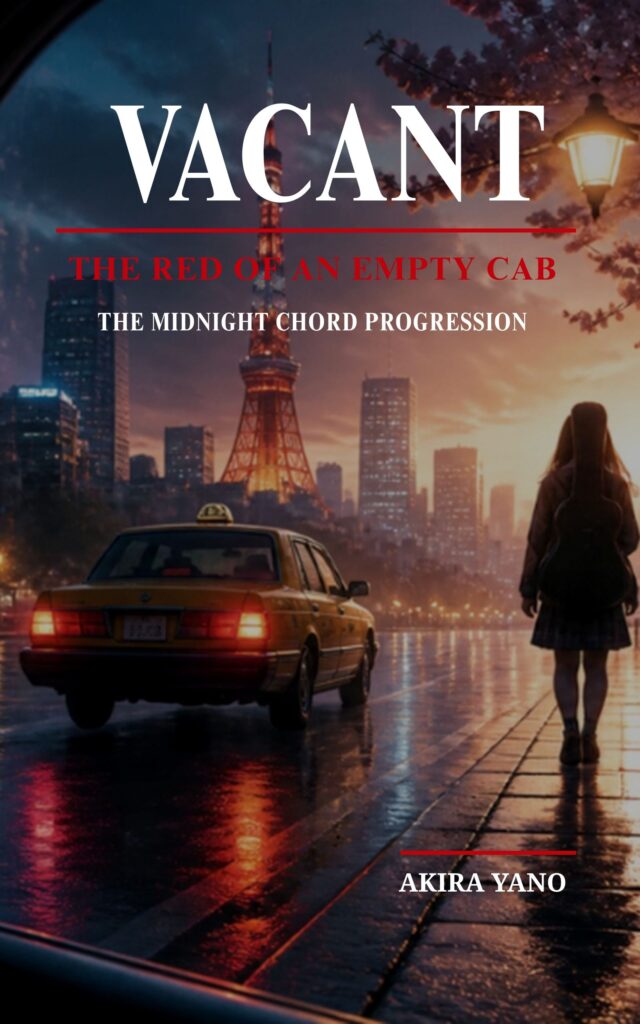
📖 English edition — VACANT: The Red of an Empty Cab: The Midnight Chord Progression → Read on Amazon
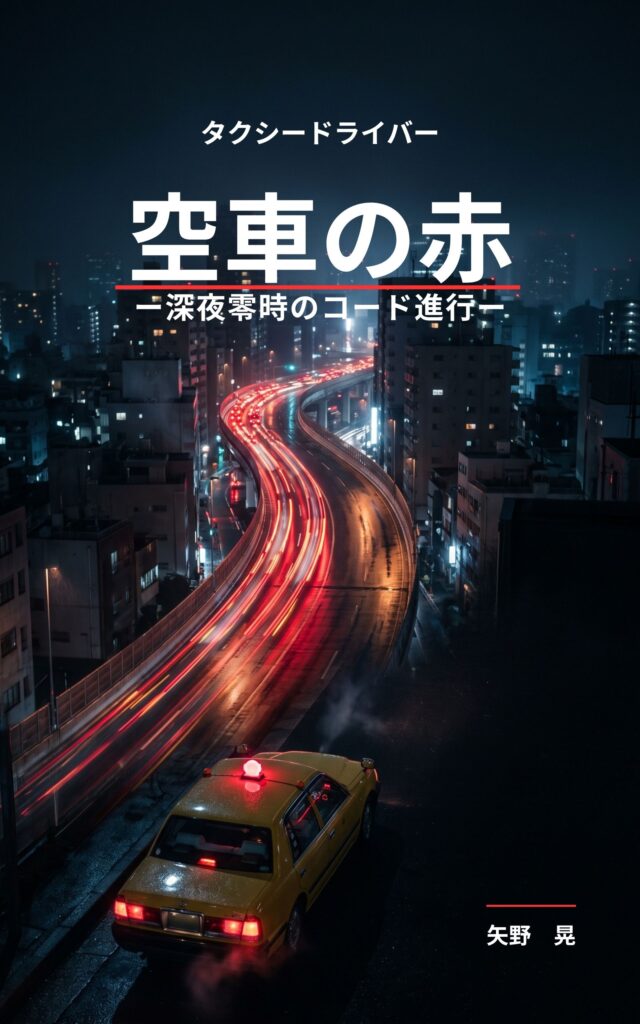
📖 Japanese edition — タクシードライバー 空車の赤: —深夜零時のコード進行— → Read on Amazon
The Kindle edition can be read on any phone with the free Kindle app. Availability and formats may differ between Amazon marketplaces.
And if you do read it, I would genuinely like to know: which Tokyo neighbourhood would you visit first?Let me know in the comments — a short review on Amazon also makes an enormous difference for an independent author.
About the author: Akira Yano is an English educator based in Japan. He has taught English in Japan for more than 35 years and trained thousands of conversation teachers, all without ever studying abroad. He has played guitar since his teens and spent years in bands — experience that shaped this novel. He writes about learning and teaching English, and about how to build real fluency inside Japan, at Akiramirai English.
▼ 作品はこちらから
📖 さらなる英語学習をお考えの方へ

基礎から学び直したい方はこちら

語彙力を強化したい方はこちら

本格的な英語学習方法を知りたい方はこちら

このガイドは、35年以上の英語教育経験を持つ矢野晃によって作成されました。数千人の講師を育て数千人の生徒を指導してきた実績に基づく、実践的で効果的な学習方法をお届けしています。