「ルールは知っているのに、なぜか不自然…」その正体は「名詞の距離感」にありました。
「文法テストでは満点が取れるのに、実際の会話になると a や the で一瞬詰まってしまう」
「仕事のメールで、自分の英語が幼く見えていないか不安になる」
もしあなたがそんな悩みを感じているなら、それは英語の「中級者」から「上級者」へと進化しようとしている素晴らしいサインです。
名詞のルールを暗記するステージは、もう卒業しましょう。ネイティブスピーカーは、文法書を思い浮かべて名詞を選んでいるわけではありません。彼らの中にあるのは、「その場の空気感(文脈)」と「相手との情報の距離」を読み取る直感的なシステムです。
全5回にわたってお届けしてきた「名詞の完全ガイド」。最終章となる本記事では、これまで学んだ知識をすべて統合し、映画、スポーツ、ビジネスといったリアルな場面で、いかに名詞を「ネイティブの感覚」で操るかを徹底解説します。
単なる「正解・不正解」を超えた、相手の心に響く「生きた英語」の核心に迫りましょう。この記事を読み終える頃、あなたの世界の見え方は、確実にネイティブの視点に近づいているはずです。
📌 「名詞の完全ガイド」シリーズを振り返る
本記事は全5回の完結編です。これまでの基礎を固めることで、今回の「実践編」の理解度が飛躍的に高まります。まだの方はぜひチェックしてみてください。
1. 会話での名詞感覚

1-1 フォーマリティレベルと名詞の選択
英語において、会話のフォーマリティ は名詞の使い方を大きく左右します。
会話レベル①:最もカジュアル(友人同士、家族との雑談)
この段階では、簡潔性と自然さが優先されます。
シーン①:映画を見た後、友人と
❌ (不自然・硬すぎる)
“The movie experience was remarkable due to its cinematographic excellence.”
⭕ (自然・カジュアル)
“That movie was amazing! The acting was so good.”
シーン②:家族の食事の時
❌ (不自然・硬すぎる)
“I have prepared nourishment comprised of various ingredients.”
⭕ (自然・カジュアル)
“I made dinner. Hope you like it!”
会話での名詞操作のポイント:
- 冠詞の省略が増える(特に既知のコンテキストで)
- 具体的で親しみやすい名詞を選ぶ
- 複雑な数量表現より、シンプルな量の表現を使う
会話レベル②:日常のフォーマル(同僚、オフィス場面)
この段階では、正確性と礼儀が重視されます。
シーン①:オフィスで同僚に相談
❌ (失礼・不明確)
“Hey, I got feedback stuff from the client, but some information is unclear.”
⭕ (専門的・明確)
“I received some feedback from the client, but I need clarification on a few points.”
シーン②:友人にイベントのお誘い
❌ (曖昧)
“There’s a thing this weekend. You wanna go?”
⭕ (丁寧で明確)
“There’s a concert this weekend. Would you like to come?”
会話レベル③:プレゼンテーション・公式な発表
この段階では、説得力と明確性が最優先されます。
シーン:会議室で提案をプレゼン
❌ (曖昧・説得力不足)
“Our stuff… I mean, our things… have been successful.”
⭕ (明確・説得力あり)
“Our company’s operations have been successful due to several key factors: excellent equipment, a talented staff, and strong market knowledge.”
1-2 「既知」と「未知」で変わる冠詞と名詞
会話では、聴き手がすでに知っている情報かどうかが、冠詞や複数形の選択に直結します。
パターン①:既知の情報(相手も知っている)→ the / 複数形
【友人同士の会話】
友人A:”Did you watch the match last night?”
(その試合=二人で話題にしていた試合 → the で OK)
友人B:”Yes! The goalie was amazing.”
(そのゴーキーパー=その試合の主人公 → the で OK)
【家族での会話】
母親:”Can you pass the salt?”
(その塩=食卓にある塩 → the で OK)
子供:”Sure. Mom, the pasta is really good today.”
(その パスタ=今食べているパスタ → the で OK)
パターン②:未知の情報(相手は知らない)→ a / 複数形
【友人への映画の紹介】
友人A:”Have you seen that new anime? It’s amazing!”
(新しいアニメ=相手はまだ知らない → a を使うか複数形)
友人B:”No, what is it? Should I watch it?”
友人A:”Yeah, it’s about a group of teenagers discovering a mystery. The characters are so cool.”
(グループ=新情報だから a group /
キャラクター=複数の個性的なキャラ → the characters に変わる)
【兄妹の会話】
兄:”I tried a new restaurant yesterday.”
(新しいレストラン=妹は知らない → a を使う)
妹:”How was it?”
兄:”Great! The food was delicious, and the service was friendly.”
(その食べ物=会話で共有された → the food)
1-3 日常会話での「名詞の省略パターン」
実際の会話では、すでに出た名詞を省略することが頻繁にあります。
カフェでの友人会話
友人A:”Did you bring your camera?”
(カメラ=既知)
友人B:”Yeah, I brought mine. Yours is better though.”
(camera を省略 → mine で代用)
友人A:”Thanks. The lighting here is perfect for photos.”
(写真=既知・明確 → the lighting)
スポーツ観戦での会話
ファンA:”Did you see that goal? Incredible!”
(ゴール=試合で明確 → 省略OK)
ファンB:”I know! The goalkeeper was sleeping.”
(そのゴーキーパー=既知・試合の登場人物 → the)
ファンA:”This team is so bad this season.”
(このチーム=話題中心 → this team)
家族での食事
父親:”This chicken is delicious. Did you add anything special?”
(このチキン=食卓の話題 → this chicken)
母親:”I used a new sauce I found online. Want the recipe?”
(レシピ=既知・相手も求めている → the recipe)
娘:”Mom, is there more rice? I want seconds.”
(ライス=食卓で明確 → more rice(不可算名詞) で冠詞不要)
2. 場面別・名詞使用ガイド

2-1 映画・エンタメ関連の会話
シーン①:映画を見た後の友人同士の会話
A:”Did you watch that horror movie everyone’s talking about?”
B:”Yeah! I watched it last night. The story was interesting, but I didn’t like the ending.”
A:”What happened?”
B:”I can’t spoil it, but the main character made a stupid decision. The acting was good though—the actress really carried the film.”
自然な名詞使用:
– “that horror movie”(話題中心・既知)
– “The story”(映画の一部・既知 → the)
– “the ending”(既知・共有可能な要素 → the)
– “the main character”(映画内で既知 → the)
– “The acting”(映画の属性・既知 → the)
– “the actress”(映画内の登場人物 → the)
なぜこれが自然か?
- 映画という「既知の作品」について話すので、その要素(story, ending, characters)には the を使う
- 新しい情報を導入する時は a / 複数形(a stupid decision)
- 映画という限定された世界なので、要素が「その映画の中での」という暗黙の指示がある
シーン②:映画の評論をSNSで投稿
Just watched the new Ghibli film! The animation is absolutely stunning. The cinematography captures such beautiful details. If you love animation, you’ll appreciate this masterpiece.
自然な名詞使用:
– “the new Ghibli film”(特定作品 → the)
– “The animation”(その映画の属性 → the)
– “The cinematography”(映画全体の映像的特徴 → the)
– “animation”(一般的な分野 → 冠詞なし)
2-2 音楽・ライブ関連の会話
シーン①:ライブに行った後
A:”How was the concert? Did you enjoy the performance?”
B:”Absolutely! The sound was perfect, and the band had great energy. The audience was so into it too.”
A:”What songs did they play?”
B:”All the hits from their new album. There were some new songs I’d never heard before—the lyrics were amazing.”
自然な名詞使用:
– “the concert”(特定のイベント → the)
– “the performance”(そのコンサート内での演奏 → the)
– “The sound”(コンサートの音響 → the)
– “the band”(出演バンド → the)
– “The audience”(その場の観客 → the)
– “the hits”(バンドの既知の有名曲 → the)
– “their new album”(バンドの新作 → 既知なら the new album)
– “some new songs”(初めて聞く曲 → a / some)
– “the lyrics”(その新曲の歌詞 → the)
なぜこれが自然か?
- ライブという「特定のイベント」なので、その要素は the を使用
- 新しい情報(未聞の曲)は a / some で導入
- バンドとリスナーの共有経験があるので、既知の曲には the hits
シーン②:音楽についての家族との会話
息子:”Mom, can I play some music while I do homework?”
母親:”Sure, but nothing too loud. What kind of music are you listening to?”
息子:”I’m into this new band. The lead singer has an amazing voice. The guitar riffs are so cool.”
母親:”That sounds nice. Just remember—music can be distracting.”
息子:”I know, but I focus better with background music.”
自然な名詞使用:
– “some music”(一般的な音楽 → some)
– “kind of music”(具体的な種類 → 冠詞による表現の違い)
– “this new band”(特定の新しいバンド → this)
– “The lead singer”(そのバンドのボーカル → the)
– “The guitar riffs”(その曲の要素 → the)
– “an amazing voice”(新情報 → an、voice:才能としての声)
– “music”(一般概念 → 冠詞なし)
– “background music”(用途で特定 → 冠詞なし)
2-3 スポーツ関連の会話
シーン①:試合を見た後の友人同士
A:”Did you see the game yesterday?”
B:”Yeah! What a match! The first half was slow, but the second half was intense.”
A:”Who won?”
B:”Our team did! The final goal was insane—the striker hit it from outside the box.”
A:”Amazing! That team is going to win the championship.”
自然な名詞使用:
– “the game”(話題のスポーツ試合 → the)
– “What a match!”(感情的な表現)
– “The first half / the second half”(試合の時間的な要素 (序数)→ the)
– “Our team”(応援チーム → 所有格)
– “The final goal”(試合内での最終ゴール → the)
– “the striker”(得点者 → the)
– “the box”(サッカー用語としての決まった領域 → the)
– “championship”(一般的な大会 → 冠詞による変化あり)
シーン②:好きなスポーツについての会話
兄:”Do you play any sports?”
妹:”Yeah, I’m on the school volleyball team. We have practice three times a week.”
兄:”How’s the team?”
妹:”Good! The team is competitive, and the coach is really supportive. The matches are tough, but I love the atmosphere.”
兄:”That’s great. Keep it up!”
自然な名詞使用:
– “any sports”(可算名詞・複数形)
– “the school volleyball team”(特定のチーム → the)
– “practice”(不可算・頻度で表現)
– “the team”(既知・指示)
– “the coach”(そのチームのコーチ → the)
– “The matches”(チームの試合 → the)
– “the atmosphere”(試合の雰囲気 → the)
2-4 食事・料理関連の会話
シーン①:新しいレストランについて
A:”I went to this amazing new restaurant last weekend.”
B:”Really? What kind of food did they serve?”
A:”Italian. The pasta was incredible, and the wine selection was great.”
B:”Did you try the desserts?”
A:”Yes! The tiramisu was the best I’ve ever had. The flavors were so rich.”
自然な名詞使用:
– “this amazing new restaurant”(新しい場所の導入 → this)
– “food”(不可算・一般的)
– “kind of food”(具体的な食類)
– “The pasta”(そのレストランで食べたパスタ → the)
– “the wine selection”(そのレストランのワイン品揃え → the)
– “the desserts”(そのレストランのデザート、複数形・種類としての複数)
– “The tiramisu”(その食事での特定のデザート → the)
– “The flavors“(その料理の複数の味わい → the)
シーン②:家族での食事時
母親:”Dinner‘s ready! Come eat before the food gets cold.”
父親:”What’s the menu tonight?”
母親:”I made pasta with vegetables. There’s some salad too if you want.”
娘:”Mom, this sauce is delicious! What’s the secret ingredient?”
母親:”Just some fresh garlic and good olive oil. Nothing complicated.”
息子:”Can I have seconds? The pasta is so good.”
母親:”Of course. There’s plenty.“
自然な名詞使用:
– “Dinner”(食事・冠詞なし)
– “the food”(その食事全体 → the)
– “the menu“(その晩のメニュー → the)
– “pasta”(不可算・物質としての判断も可)
– “vegetables”(複数形・様々な野菜)
– “some salad”(サラダという物質 → some + 不可算)
– “this sauce”(目の前のソース → this)
– “the secret ingredient”(隠れた材料 → the)
– “garlic / olive oil”(物質・不可算)
– “The pasta”(その食事での特定のパスタ → the)
– “plenty”(十分な量 → 不可算)
なぜこれが自然か?
- 家族間での会話では冠詞が簡潔化する傾向
- 目の前にある食べ物には this / the を使う
- 食材は不可算名詞が多い(pasta, salad, garlic, oil)
2-5 趣味・日常活動の会話
シーン①:友人との週末の予定
A:”What are you doing this weekend?”
B:”I’m going hiking. Want to come?”
A:”Hiking? I haven’t done that in forever. Where are you going?”
B:”To the mountains. We’re leaving early in the morning. The views are supposed to be incredible.”
A:”How long does it take to get there?”
B:”About two hours by car. I’m bringing snacks and water. You should bring a backpack.”
自然な名詞使用:
– “this weekend”(時間 → 冠詞なし)
– “the mountains”(既知の地理的場所 → the)
– “the morning”(時間帯 → the)
– “The views”(その場所の景観 → the)
– “two hours”(時間単位 → 数量 + 単位)
– “snacks “(いくつかの種類や個数)
– “water”(液体・不可算)
– “a backpack”(新情報・導入 → a)
シーン②:読書についての家族での会話
娘:”I’m reading this amazing book. Can I tell you about it?”
父親:”Sure! What’s it about?”
娘:”It’s a mystery novel. The main character is a detective trying to solve a crime. The plot is so surprising!”
父親:”What’s the title?”
娘:”‘The Hidden Truth.’ The author is really talented. Have you read anything by her before?”
父親:”No, but the title sounds interesting. Maybe I’ll read it after you finish.”
自然な名詞使用:
– “this amazing book”(特定の本の導入 → this)
– “it”(代名詞で省略)
– “mystery novel”(特定のジャンル)
– “The main character”(その本内での主人公 → the)
– “a detective”(職業・新情報 → a)
– “a crime”(具体的な事件 → a)
– “The plot”(その物語のプロット → the)
– “the title”(その本の題名 → the)
– “The author“(その本の著者 → the)
– “her before”(著者への指示 → 既知化)
2-6 ビジネス環境での名詞操作
シーン①:朝のスタッフミーティング
マネージャー:”Morning, everyone. We have new equipment arriving today. The team will need training by tomorrow. Any questions?”
部下A:”Do we have the schedule? I need information for planning.”
マネージャー:”I’ll send it via email. The IT team is handling logistics.”
自然な名詞使用:
– “new equipment”(具体物・不可算)
– “The team”(既知・指示)
– “training”(不可算)
– “Any questions”(可算)
– “the schedule”(特定のスケジュール、加算)
– “information”(不可算)
– “The IT team”(特定のチーム)
– “logistics”(抽象名詞、不可算)
シーン②:同僚へのメール相談
Hi Sarah,
I wanted to get your feedback on the project proposal I sent last week.
I need some clarification on the budget section.
Do you have time to discuss the details this week?
Best regards,
Tom
自然な名詞使用:
– “your feedback”(既知・相互関係、不可算)
– “the project proposal”(既知・指示、複合名詞)
– “some clarification“(不可算)
– “the budget section”(既知・特定の部分)
– “time”(不可算)
– “the details”(既知・指示、複数形)
3. 文脈による名詞の「柔軟性」

3-1 同じ名詞が「可算」にも「不可算」にもなるケース
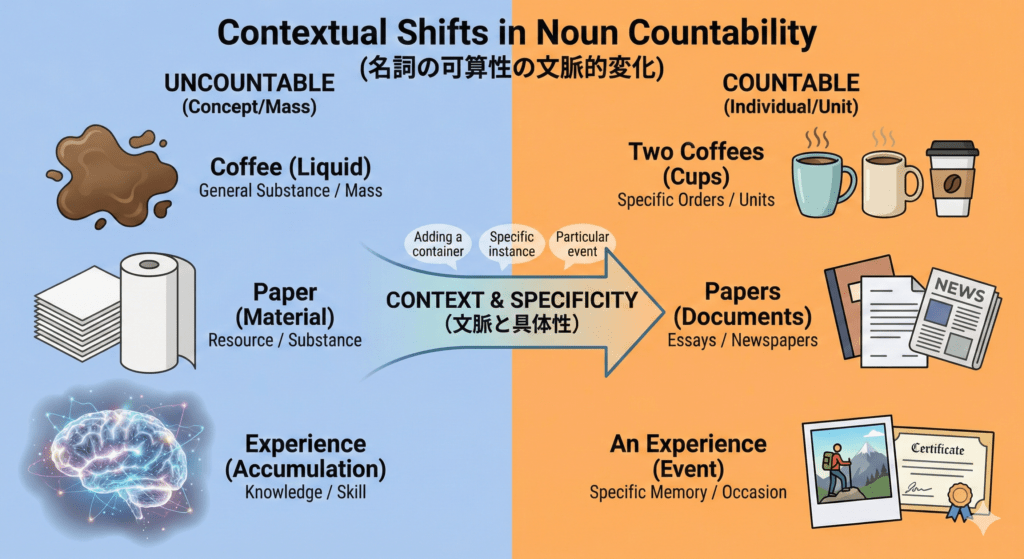
ケース①:「experience」(経験)
- 不可算での使用(蓄積としての経験)
-
“He has extensive experience in marketing.”
- 可算での使用(具体的な出来事)
-
“We had an unforgettable experience in Japan.”
“I’ve had many difficult experiences with technical failures.”
日常会話での例:
友人A:”How was your trip?”
友人B:”Amazing! It was an incredible experience.”
(具体的な旅という出来事 → experience は可算)
友人A:”Do you have experience with video editing?”
友人B:”Yeah, I have some experience, but not much.”
(スキル・蓄積としての経験 → experience は不可算)
ケース②:「paper」(紙 vs. 論文)
- 不可算での使用(物質としての紙)
-
“We need more paper for the printer.”
- 可算での使用(書類・論文)
-
“Can you submit your papers by Friday?”
“I need to write three papers for my courses.”
日常会話での例:
子供:”Mom, I need paper for my drawing.”
(物質としての紙 → 不可算)
学生:”I have to submit five papers this semester.”
(課題としての論文 → 可算)
ケース③:「coffee」(飲み物 vs. 杯数)
- 不可算での使用(物質・一般的な飲み物)
-
“I love coffee.”
“How much coffee do you drink daily?” - 可算での使用(杯数・容器単位)
-
“I’ll have two coffees, please.”
“We served five coffees at the meeting.”
カフェでの会話:
友人A:”Want some coffee?”
(一般的な飲み物 → 不可算)
友人B:”Sure! Actually, make it two coffees.”
(カフェで注文:杯数 → 可算化)
カフェ店員:”That’s one cappuccino and one espresso?”
(具体的なドリンク → 可算のまま)
ルール:
- 同じ名詞でも「物質 / 個体」「抽象 / 具体」で可算性が変わる
- 容器や単位が暗黙的に関わると可算化する傾向
- 文脈で「何を指しているか」が明確に判断できること
💡 さらに深く知りたい方へ:冠詞と名詞の深い関係
今回の記事では「文脈」に焦点を当てていますが、そもそも「a と the の基本ルールがまだ不安……」という方は、こちらの[冠詞の徹底攻略ガイド]も併せて読むと、名詞のパズルがすべて完成します。
4. 「脱・初心者」から「洗練された使い手」へ
4-1 初級者と中級者の名詞使用の違い
| 段階 | 特徴 | 例 |
|---|---|---|
| 初級者 | ルール通りが最優先。複数形を多用。冠詞選択に迷う。 | “I have many informations. I love the music.” |
| 中級者(初期) | ルールは理解したが、応用場面で不安。フォーマリティの違いに気づき始める。 | “I need information, but… wait, is it ‘the’ or just ‘information’?” |
| 中級者(発展) | 文脈による柔軟性を理解。会話と執筆で使い分けられる。 | “The movie was great! I loved the ending.” ✓ |
| 上級者 | 無意識で適切な名詞を操る。スタイルの違いを意図的に活用。 | “The cinematic nuances of the film offer profound philosophical insights.” |
4-2 「同じ場面を複数のレベルで表現」
テーマ:「友人と映画について話す」
初級レベル
“I watch a movie. The movie is good.
I like the character. The story is interesting.”
中級レベル
“I watched this amazing movie yesterday. The plot was unexpected, and the acting was really impressive. Have you seen it?”
(昨日、この素晴らしい映画を観ました。ストーリーの展開が予想外で、演技も本当に印象的でした。あなたはもう観ましたか?)
上級レベル
“The cinematic execution was masterful—the director’s subtle use of framing and the nuanced character development created an immersive experience.”
(映像表現は見事で、監督による巧みなフレーミングの使い方や、繊細に描かれた人物描写が、観る者を物語の世界に深く引き込む体験を生み出していました。)
5. 練習問題

練習問題①【冠詞・名詞選択】
(a / the / 無冠詞、単数・複数を適切に補ってください)
- I watched ___ movie everyone is talking about. ___ ending was shocking.
- Can you pass ___ salt?
- I need ___ information about the schedule.
- We had ___ unforgettable experience during our trip to Italy.
- ___ music helps me focus when I work.
- She works for ___ IT company in Tokyo. ___ company develops AI software.
- I ordered two ___ coffees and ___ sandwich.
- ___ audience was completely silent during the performance.
練習問題②【場面別・自然な表現選択】
不自然な文を、その場面に合う自然な英語に書き換えてください。
- The cinematic execution was remarkable due to its narrative structure.
(友人同士・映画の感想) - I got some stuff from the client, but it is unclear.
(オフィス・同僚への相談) - I prepared nourishment comprised of vegetables.
(家族での食事) - I liked music. Sound was good.
(ライブ後の会話)
練習問題③【可算・不可算の判断】
下線部の名詞は 可算(C)/不可算(U) のどちらか答え、理由を簡潔に説明してください。
- I have some experience in marketing.
- That trip was an amazing experience.
- We need more paper for the printer.
- I have to submit three papers this semester.
- I’ll have two coffees, please.
練習問題④【レベル別書き換え】
次の文を 中級レベル に自然に書き換えてください。
- I watched a movie. The movie was good. I liked the characters.
練習問題⑤【文脈で冠詞を選択】
括弧内で最も自然な表現を選んでください。
- I watched ( a / the ) movie last night. ( The / A ) story was really surprising.
- My family loves ( coffee / the coffee ) in ( the / a ) morning.
- ( A / The ) music at ( the / a ) concert was incredible!
- I need ( some / many ) advice on ( the / a ) book I’m reading.
解答
練習問題①
- the / the → 話題として共有されている映画・その一部
- the → 目の前・共有されている塩
- some / 無冠詞 → information は不可算
- an → 具体的な出来事としての experience(可算)
- 無冠詞 → 音楽一般
- an / the → 初出は a/an、その後は the
- coffees / a → 杯数として可算化
- The → その場の観客という限定された集団
練習問題②
- That movie was amazing. The story really pulled me in.
→ 友人同士では抽象的・学術的名詞(cinematic execution)は不自然。 - I received some feedback from the client, but I need clarification.
→ stuff → feedback / clarification(ビジネス向け名詞) - I made dinner with some vegetables.
→ 家族間では簡潔な名詞+動詞が自然。 - The music was great, and the sound was perfect.
→ ライブという「特定イベント」内 → the を使用。
練習問題③
- U → 蓄積されたスキル・経験
- C → 特定の出来事
- U → 物質としての紙
- C → 課題・論文
- C → 杯数という単位が暗黙に存在
練習問題④
- I watched this great movie, and the characters were really memorable.
- this → 話題導入
- characters → 個性ある複数
- good → 具体的評価語へ
練習問題⑤
- a movie / The story
(新しい映画の導入 → a movie)
(その映画のストーリー → The story) - coffee / the morning
(一般的なコーヒー愛好 → coffee)
(時間帯 → the morning) - The music / the concert
(そのコンサートの音楽 → The music)
(特定のコンサート → the concert) - some advice / the book
(advice は不可算 → some advice)
(話題の本 → the book)
まとめ:名詞の「感覚」から「スキル」へ

全5回のシリーズを通じて、私たちは「名詞」という、英語の土台にして最大の難所を冒険してきました。
最後にもう一度、私たちが手に入れた「洗練された使い手」への3つの視点を振り返りましょう。
- 「ネイティブの視点」をインストールする 名詞を単なる単語としてではなく、物理的な「数え方」や「輪郭」として捉える。
- 「文脈の力」を信じる 同じ単語でも、場面によって可算・不可算は変わる。「例外」を恐れず、その場の柔軟性を楽しむ。
- 「目的」に合わせて使い分ける カジュアルな会話での「簡潔さ」と、ビジネスでの「正確さ」。そのギャップこそが英語の醍醐味です。
継続学習へのアドバイス:完璧主義を捨て、「観察者」になろう
名詞の可算・不可算、そして冠詞の選択。これらは私たち日本人にとって、英語学習における「最後の壁」と言っても過言ではありません。だからこそ、今日明日で完璧にできなくても、決して落ち込まないでください。
これから英語に触れるときは、ぜひ「観察者」になってみてください。
- 「なぜ今の映画のセリフでは、複数形じゃなく単数だったんだろう?」
- 「このニュース記事、なぜここで the を使ったのかな?」
そんな小さな「なぜ?」の積み重ねが、あなたの脳内にネイティブと同じ回路を作っていきます。一つひとつの名詞を丁寧に扱うあなたの姿勢は、必ず相手に対する「信頼」と「配慮」として伝わります。
あなたの英語は、すでに「ただ通じるだけ」の段階を超え、より豊かで自然なものへと変化し始めています。その変化を楽しみながら、自信を持って次の一歩を踏み出しましょう!
🚀 名詞をマスターしたあなたへ:次のおすすめステップ
名詞という「土台」が完成したら、次はそれを動かす「動詞」や、名詞を豊かに彩る「形容詞」の感覚を磨きましょう。
- [中級者のための動詞時制マスター]:名詞とセットで「生き生きとした文章」を作る
- [前置詞のイメージ学習法]:名詞の「位置関係」を直感的に捉える
- [ビジネス英語のライティング術]:今回学んだ名詞の知識を、実務でどう活かすか?
英文法の迷宮を抜け出し、自信を持って英語を操る旅を続けましょう!
📖 さらなる英語学習をお考えの方へ

基礎から学び直したい方はこちら
語彙力を強化したい方はこちら
本格的な英語学習方法を知りたい方はこちら
このガイドは、35年以上の英語教育経験を持つ矢野晃によって作成されました。数千人の講師を育て数千人の生徒を指導してきた実績に基づく、実践的で効果的な学習方法をお届けしています。